Alvin Dewey and Marie Dewey’s marriage
In Cold BloodAlvin Dewey and Marie Dewey’s marriage is depicted as a practical, affectionate partnership whose everyday habits are gradually overtaken by the Clutter investigation. They share paid work and household labor, raise two sons, and build their life around faith and plans for a home on the land Dewey bought. As the case absorbs his attention, Marie becomes both the witness to its domestic cost and the person who fears for his health; the investigation repeatedly enters their kitchen, interrupts their conversations, and leaves the question of a return to normal unanswered.
Shared Work and a Home in Prospect
Dewey and Marie’s ordinary life rests on cooperation rather than a rigid division of household tasks. Both work outside the home, Marie as an office secretary, and they take turns cooking and washing dishes. Marie recalls that acquaintances teased Dewey about exchanging the sheriff’s gun for an apron when he came home. The joke captures the familiarity of their domestic arrangement: his public authority does not exempt him from the work they share at home.
They are also saving to build a house on a farm Dewey purchased in 1951. The two hundred and forty acres lie several miles north of Garden City. In fine weather, especially when the wheat stands high and ripe, Dewey drives there to practice his draw, shooting at crows or tin cans. He also imagines the future house and garden, and trees that have not yet been planted. His hope that oaks and elms will one day shade the open land gives the couple’s plans a patient horizon: a settled home they are preparing for, not yet inhabiting.
Faith is woven into their shared routine. Church on Sundays, grace before meals, and prayers before bed are part of their life together. Marie describes returning tired from work to coffee on the stove and, sometimes, a steak in the icebox; the boys make a fire to cook it, and the family talks over the day. Her gratitude is not presented as mere observance but as a response to the concrete comfort of being together. This ordinary domestic rhythm becomes the measure against which the disruptions of the investigation are felt.
The Investigation Enters the Household
The Clutter case intrudes first as sound and unease. Marie wakes when Dewey leaves their bed and answers the telephone again. Their younger son, Paul, is crying; though he only hazily understands the reasons for the turmoil, he feels threatened by the calls, strangers at the door, and the worry in his father’s eyes. At breakfast he breaks into tears. His older brother tries to reassure him by promising to teach him poker the next day. The children’s response makes visible what the adults cannot keep outside the home: the investigation has become a presence in family life.
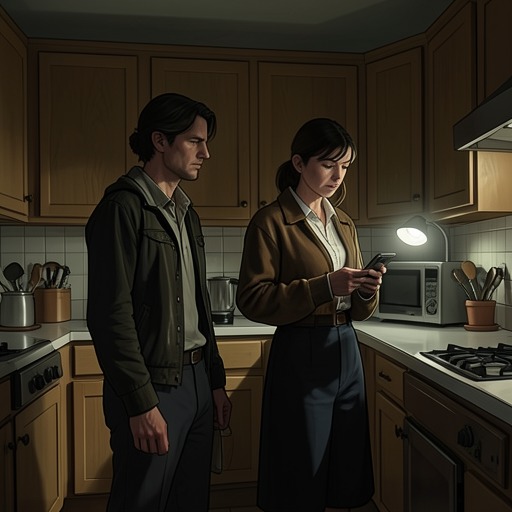
Dewey’s work also arrives in the kitchen as evidence. Marie finds him waiting for coffee with photographs from the crime scene spread across the table, their bleak stains against its pretty fruit-patterned oilcloth. She had previously declined his offer to look at them because she wanted to remember Bonnie Clutter and the family as they had been. Now, seeing the photographs occupy a place of ordinary domestic use, she confronts the case’s incursion without choosing to inspect them. Dewey wonders whether their sons should stay for a few days with his widowed mother, whose home is nearby. His unfinished explanation registers how uncertain he is about when the disruption will end.
Marie asks whether they will ever return to normal living. The question returns later, when she presses Dewey for an answer and the telephone interrupts his attempt to reply. The interruption is small but decisive: even a conversation about the state of their marriage and home cannot hold its place against the case. The text offers no answer from Dewey and no quick restoration of their former routine.
Fixation, Concern, and Mutual Knowledge
By Christmas, Dewey’s concentration has become conspicuous to their friends. Caught in holiday traffic beneath decorations, he realizes he has not bought gifts for Marie or the boys; his mind has automatically dismissed anything not connected with the Clutter case. Marie and others have begun to notice how completely his attention is occupied. The forgotten presents are not treated as proof that he has ceased to care for his family. Rather, they show how the investigation has crowded out acts through which care would ordinarily be expressed.
Clifford R. Hope, Jr., a close friend, tells Dewey that he never talks about anything else. Dewey acknowledges that the case is all he thinks about. He fears that if it remains open, he could spend years following tips and checking possible connections to murders elsewhere. He also explains that he feels he has come to know Herbert Clutter and the family better than they knew themselves, and that they haunt him until he understands what happened. His words clarify the force of the work, but they also show the limit Marie is living with: the case’s unresolved state governs the attention Dewey brings home.
Marie’s concern is practical as well as emotional. After Dewey brings home a manila envelope containing photographs and dossiers of two suspects, she listens as he recounts Floyd Wells’s information and says he has a hunch. Marie cautions that the information may not be true. She has seen hundreds of leads go nowhere and is worried about Dewey’s condition: he is emaciated and smoking sixty cigarettes a day. Her caution does not amount to indifference or opposition to the investigation; it reflects her awareness of the physical cost of his hope, and of the disappointment that has followed earlier possibilities.
The Envelope and the Unfinished Answer
The envelope changes the atmosphere of the household. Marie is preparing supper and telling Dewey about a run of family mishaps: their cat has attacked a cocker spaniel across the street, Paul has fallen from a tree, and their twelve-year-old son, named for his father, has started a rubbish fire that threatens the neighborhood and brings the Fire Department. As she speaks, she notices Dewey’s flushed face and recognizes his elation. He gives her the envelope rather than explaining at once. She dries her wet hands, sits at the kitchen table with her coffee, and opens it to find police photographs and dossiers.
Marie studies the portraits, then urges Dewey to consider what it would mean if the blond suspect came toward him. Her unease is shaped by what she sees in the photograph, but she has already warned that Wells’s account may be mistaken. Dewey admits that it may not be the truth, while maintaining his hunch. Marie pushes the pictures back into the envelope and wishes he had not shown them to her. The exchange holds together the distinct pressures of their marriage: his need to share a possible breakthrough, her reluctance to be drawn further into images of the case, and her effort to protect him from another collapse of hope.
Their relationship is therefore shown not through a dramatic rupture but through repeated negotiations between shared life and Dewey’s absorption in his work. They retain the habits of partnership—coffee, meals, concern for their sons, plans for a future home—even as the telephone and the evidence repeatedly break into them. Marie’s questions about normal life remain unanswered in the scenes presented; the marriage’s defining tension is the cost of waiting for Dewey to know what happened.